
16 June 2026
The Battle for Streaming Supremacy: A Game of Thrones for Sport
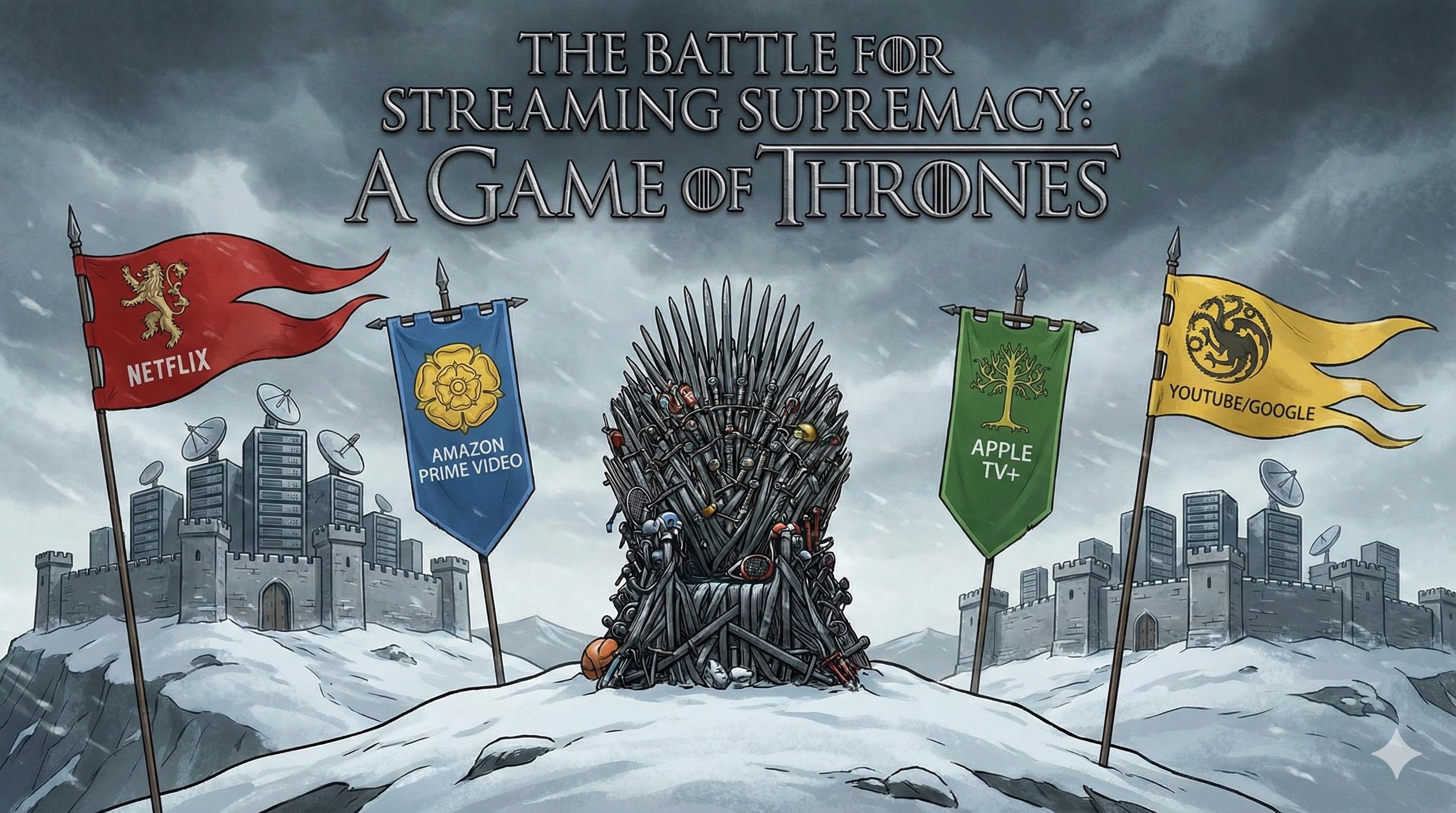
When I first wrote about the Streaming War in 2024, the tech titans were circling the perimeter. They have since breached the walls, and the great houses of media have begun consuming one another. The fight is no longer about who wins a rights package. It is about who is left standing. Here is how the houses stand in 2026.
The Broadcasters (House Stark)
"The North Remembers. It is also up for auction. And it has Arya in its ranks."
Warner Bros Discovery, having already lost its NBA rights, spent late 2025 fielding bids from Netflix, Paramount and Comcast. It agreed an initial deal with Netflix, then took a superior all-cash offer from Paramount Skydance, jilting one suitor at the altar for another. The boards signed in February 2026 at $31 a share, valuing WBD at around $111 billion. Shareholders approved it in April, and the US Department of Justice cleared it in June, finding it unlikely to harm competition. It is not done yet. California's attorney general is still weighing a legal challenge, and more than 1,400 Hollywood figures have signed an open letter against the consolidation. But the house is all but sold.
This is the Red Wedding, except the house being slaughtered is one of the founding broadcasters of the modern rights era, and it walked in willingly.
The strategy for those still standing alone is bundling: recreating the cable bundle in a digital world. But subscription fatigue is the White Walker army at the wall, thinning the audience faster than the bundles can rebuild it. The broadcasters keep a seat at the table, even if the table now belongs to someone else.
Don't write them off, though, or you'll be making the same mistake everyone makes about the Starks. Remember, they have Arya in their ranks. More on her later.
Amazon (House Lannister)
"A Lannister always pays his debts. And buys the NBA."
Amazon played its hand with cold precision. It did not fight every battle; it bought the castles that mattered. It now holds a slice of the NBA and a firm grip on the NFL's Thursday Night Football, and it has folded commerce into content in a way no broadcaster can match. You do not just watch the game. You buy the shirt before the final whistle.
There is no romance in the strategy, and that is the point. Amazon does not care about the love of sport. It cares about the Prime subscription, and sport is the most reliable engine for it. The gold, the distribution and now the cultural weight are all in hand.
Apple (House Tyrell)
"Growing strong. Inside a walled garden."
Apple remains wealthy, stylish and selective. The MLS deal was executed flawlessly, and the Messi era turned it into a driver of subscriptions. But the ambition has a ceiling, and the ceiling is control. Apple wants the whole ecosystem: production, scheduling, and data.
That insistence has stalled its march into other Tier 1 rights. Federations are wary of handing over the keys to the kingdom. Apple has the best user experience in the realm and the patience to wait. Whether it learns to share the garden will determine whether it becomes a true power or remains a beautiful, isolated one.
Netflix (House Martell)
"Unbowed, unbent, unbroken. And now, unpredictable."
Netflix swore for years it would not do live sport. Then it pivoted, because Drive to Survive brought fans to the door and only live events kept them inside. It started with stunt sport, the Tyson and Paul fight that drew over 60 million households, and moved into the mainstream with NFL Christmas Day games and WWE.
By 2026, the strategy will have come into focus and will be more clever than simply buying rights. Netflix does not want every match. It wants the moments everyone is watching and the conversation around them. For the men's World Cup, it did not chase the live games, which sit with Fox, the BBC and ITV. It took the talk instead, signing The Rest Is Football, the Lineker, Shearer and Richards podcast, as a daily show filmed in New York and streamed worldwide.
It has bought the next two Women's World Cups outright for the US, where the rights are still affordable, and the growth is steepest. And it walked away from Warner Bros Discovery rather than overpay when Paramount raised the stakes.
That is the discipline. Netflix will spend enormous sums, but only on what everyone is watching, and only at a price that the moment is worth. It is buying cultural relevance, rather than a rights portfolio, and doing so for a fraction of what broadcasters spend to own the whole season.
Alphabet / Google (House Targaryen)
"Fire and blood. And algorithms."
If there is a favourite for the Iron Throne, it is Google. It holds three dragons: Search, YouTube and AI.
While the other houses fight over rights fees, YouTube has quietly become the default television for an entire generation. The highlights, the fan channels, the podcasts, the reaction videos all live there. Google does not just hold live rights through NFL Sunday Ticket. It holds the culture around the sport.
And in 2026, the live numbers caught up with the cultural grip. YouTube's NFL broadcast from Brazil broke streaming records, with an average audience of more than 17 million and over a million viewers outside the US. That is the shift. YouTube is no longer only where you watch the highlight after the game; it is now where millions watch the game itself, at a scale the broadcasters recognise and fear.
It is also where fans now watch together. The watch-along, a creator reacting live to a game while thousands stream alongside, has become its own form of broadcast, communal in a way linear television lost years ago. The match plays elsewhere; the experience happens on YouTube.
Its real weapon is still the algorithm, trained on decades of sports data to build personalised experiences that linear television cannot answer. As one hedge fund investor put it to me, in the end, Google wins because it owns the audience, not just the content. Rights expire. Attention does not, and Google owns the platform attention lives on.
Who sits on the Iron Throne?
The war is not coming. It is here, and it has turned cannibal. The kingdom is fragmented, and the viewer, the peasant in this story, pays more for scattered services than they ever paid for cable.
If anyone is winning, it is still House Targaryen. Google does not need to hold the most rights, because it owns the ground on which the whole war is fought. YouTube is where the highlights live, where the arguments happen, and increasingly where the live game is watched too. The other houses are tenants on Google's land.
But the most interesting figures on the board are not the great houses at all. They are the Faceless.
A single YouTuber bought the rights to French second-division rugby and put it on YouTube for free. A Brazilian creator channel now outbids broadcasters for the World Cup. The Bundesliga handed Friday-night games to two football podcasts. A player like Bryson DeChambeau is arguably worth more to LIV for his YouTube channel than for his swing. The creator has become a rights holder. No castle, no army, just a camera and an audience, and suddenly able to go where the great houses cannot.
This is the Arya Stark of the story. Not the biggest or the loudest, but the one who can wear any face, slip through any door, and serve whichever side the moment demands. In a fragmented kingdom, agility beats scale. Silence and invisibility turn out to be powers of their own.
Winter Is Coming for Sport
There is a darker truth underneath the spectacle. The houses are not growing the game. They are creaming off the top, the marquee events, the biggest moments, the audiences already won, and leaving the rest behind. That is good business and bad for sport. Leagues and federations are built on the unglamorous middle, the early rounds, the smaller competitions, the slow work of turning a casual viewer into a lifelong fan. A pick-and-mix market serves the giants and starves the base. Cream the top for long enough, and there is less competition, fewer stars, and a thinner game underneath.
And here is what the great houses overlook while they fight over the throne. Sport is not a normal asset class. It does not throw off returns like a streaming catalogue or a retail business; it needs investment and, above all, reach. The single most valuable thing in the whole ecosystem is a large, free, aggregated audience, the casual millions who become the lifelong fans, and that is the one thing a paywall cannot build. By design, subscription fragments and shrinks the very audience sport depends on to grow.
This is why House Stark still matters. The free-to-air broadcasters will never sit at the top table of rights again; those days are gone. But they hold the function the platforms cannot replicate: assembling the free, mass audience that keeps a sport alive at the bottom of the pyramid. Their mistake would be to die defending linear television. The future is a gentle tactical shift to streaming, and BBC iPlayer, already the largest streaming service in the UK, is proof that it can be done. A public broadcaster can keep its reach, principles, and values intact without ever winning another rights war.
The Iron Throne may yet be melted down. The one thing no house can conquer is the simple need for content people actually want to watch, and that has to be grown, not just bought. The giants own the platforms. But someone still has to feed the base, and in the long winter coming for sport, the old broadcasters may turn out to matter more than the houses fighting over the throne ever expected.